Pure Peptides in the UK: What the Term Really Means
Short answer: “Pure peptides” usually refers to synthetic or isolated peptide materials with a stated level of chemical purity, but the phrase is not meaningful on its own. For scientific use, purity has to be linked to identity testing, analytical methods and the intended context of use.
What are peptides?
Peptides are short chains of amino acids joined by peptide bonds. Amino acids are the building blocks of proteins, but peptides are generally smaller and simpler than full proteins. In biology, peptides can act as signalling molecules, structural fragments, hormones, enzyme substrates or parts of larger protein systems.
Some peptides occur naturally in the body and in foods. Others are made in laboratories for research, analytical standards, materials science, cosmetics research or pharmaceutical development. The same basic chemistry can be discussed in many different settings, which is why context matters when people search for terms such as pure peptides UK.
What does “pure” mean for a peptide?
In chemistry, purity describes how much of a sample consists of the intended molecule compared with related or unrelated impurities. A peptide sample may contain the target sequence plus small amounts of by-products from synthesis, incomplete chains, modified forms, salts, water or residual solvents.
A purity figure is therefore not a broad guarantee of suitability. It is a measurement result, usually tied to a particular analytical method. A peptide described as 95% pure by one method may still require identity confirmation and other checks before it is appropriate for a specific research purpose.
Peptide identity and purity are related, not identical
Two questions are often confused:
- Identity: is the molecule the peptide sequence it is claimed to be?
- Purity: how much of the sample is the intended molecule rather than impurities?
A sample can show a high purity value while still requiring confirmation that the sequence, mass and chemical form are correct. Conversely, identity testing can show that the target peptide is present, while purity testing shows that significant impurities are also present.
How peptide purity is commonly assessed
Several established analytical techniques are used in peptide science. The right combination depends on the peptide, the research question and the required level of characterisation.
Chromatography
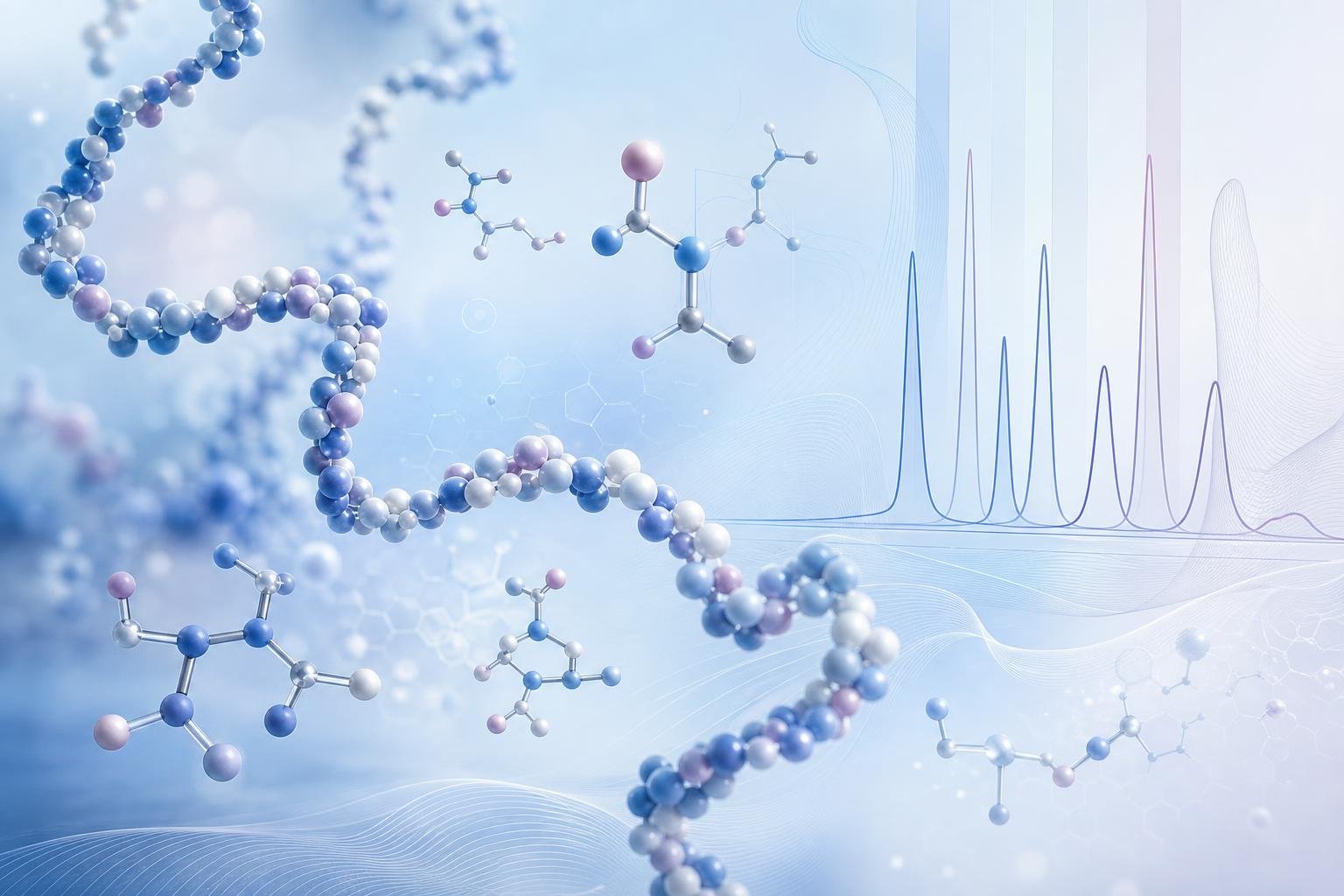
High-performance liquid chromatography (HPLC) and ultra-performance liquid chromatography (UPLC) separate compounds in a sample. They can estimate the relative amount of the main peptide peak compared with other detectable peaks. This is one of the most common ways to report peptide purity.
Mass spectrometry
Mass spectrometry helps confirm whether the molecular mass matches the expected peptide. It is especially useful for checking identity and detecting some modifications or truncated sequences. It does not replace every other quality test, but it is central to modern peptide characterisation.
Additional checks
Depending on the context, other information may be relevant, such as water content, counter-ion form, amino acid analysis, residual solvent assessment or sterility-related testing. Not every peptide project needs the same data, and not every purity claim covers these additional characteristics.
Why synthesis creates impurities
Many research peptides are produced by solid-phase peptide synthesis. In simplified terms, amino acids are added one at a time to build the desired sequence. This is a powerful method, but no chemical process is perfect. Side reactions, incomplete coupling steps or protective group issues can generate closely related molecules.
Longer or more complex peptides can be harder to make and purify than short, simple sequences. Certain amino acid patterns can also affect solubility, folding tendency and analytical behaviour. This is why the same headline purity percentage may not carry the same practical meaning across different peptides.
Why intended use changes the conversation
The word “peptide” appears in many areas: academic research, laboratory reagents, diagnostic assay development, cosmetic ingredient discussions and medicine development. These are not interchangeable categories. A peptide prepared for one purpose should not be assumed to be suitable for another.
In the UK, as elsewhere, the legal and scientific expectations depend on intended use and claims. A material discussed as a research reagent is different from a medicine, a cosmetic ingredient or a consumer product. This article is an educational overview of the terminology, not guidance on personal use, treatment, diagnosis or procurement.
Common misunderstandings about “pure peptides”
- “Pure” does not mean risk-free. Chemical purity is only one aspect of scientific suitability.
- A percentage is not the whole specification. The analytical method, identity data and sample form matter.
- Peptides are not all the same. Length, sequence, charge, solubility and stability can vary widely.
- Research materials are not consumer health products. Laboratory terminology should not be read as a personal-use claim.
- Natural and synthetic are not quality labels by themselves. Both require appropriate characterisation in scientific settings.
Reading purity information critically
In scientific documentation, a useful purity statement is usually specific. It may identify the method used, the date of analysis, the batch or lot, the expected molecular mass and the observed result. A vague claim of being “pure” or “high grade” carries limited scientific value without supporting information.
It is also important to notice what is not being claimed. A chromatographic purity result does not automatically describe biological activity, stability over time, absence of every contaminant or suitability for use in humans or animals. These questions require separate evidence and, where relevant, appropriate regulatory assessment.
Stability and storage are part of the science
Peptides can be sensitive to moisture, temperature, light, oxidation or repeated handling. Some degrade more readily than others. Stability depends on sequence and formulation as well as environmental conditions. Because of this, purity can change over time if a material is not maintained under conditions validated for that specific peptide.
For editorial and research discussions, it is safest to treat stability as a property to be demonstrated rather than assumed. A peptide that was analytically characterised at one point may need further evaluation if conditions, timing or handling have changed.
FAQ
Does “pure peptide” mean the same as pharmaceutical grade?
No. A purity description is not the same as a pharmaceutical quality standard. Medicines require extensive development, manufacturing controls, safety evidence and regulatory assessment beyond a simple purity percentage.
Is a higher purity percentage always better?
Not necessarily. Higher purity may be important for some experiments, but the appropriate specification depends on the research purpose, analytical method and required controls. Identity, stability and impurity profile can be just as important.
Can purity data prove biological effects?
No. Purity data describes chemical composition under specific testing conditions. Biological activity, safety and effectiveness require separate evidence from appropriate scientific studies.
Bottom line
“Pure peptides” is a broad phrase that needs careful interpretation. In scientific terms, the key questions are what peptide is being discussed, how its identity was confirmed, how purity was measured and what the material is intended for. Without that context, the phrase is more of a marketing-style shorthand than a complete scientific description.
Intended for in-vitro laboratory research only. Not for human or animal consumption.