GHK-Cu: what the copper peptide is and what research shows
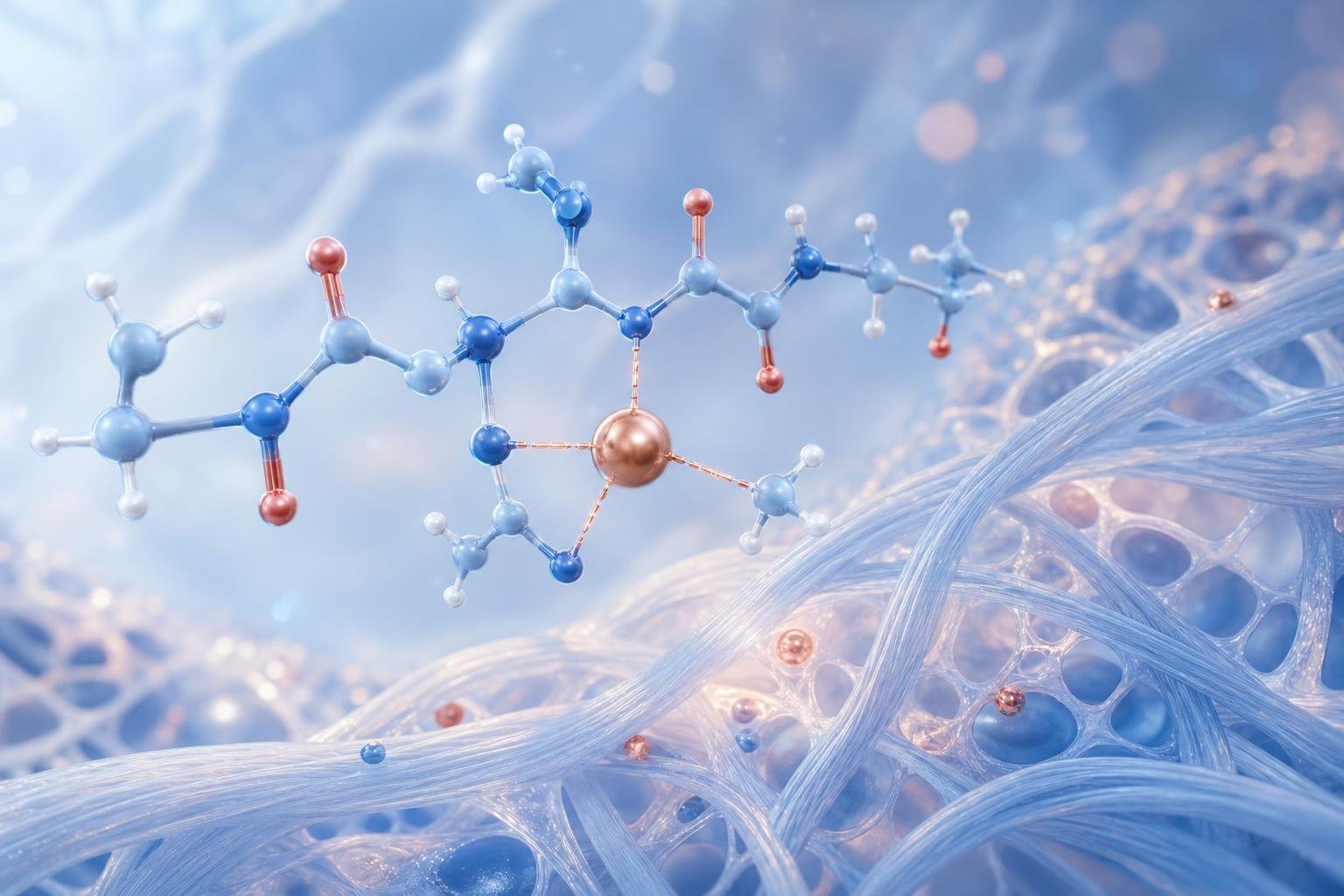
GHK-Cu is a small peptide that binds copper and is studied for its role in skin and tissue biology. It appears to influence processes such as extracellular matrix turnover, oxidative stress responses and repair signalling, but much of the evidence comes from laboratory and early-stage research rather than large clinical trials.
What is GHK-Cu?
GHK-Cu stands for glycyl-L-histidyl-L-lysine copper complex. In plain terms, it is a short chain of three amino acids, known as a tripeptide, joined to a copper ion. The peptide part is GHK; when it binds copper, the complex is commonly written as GHK-Cu.
GHK has been identified naturally in human plasma and other biological fluids. Copper is an essential trace element involved in many enzymes, including those linked with connective tissue formation, antioxidant defence and energy metabolism. GHK-Cu is therefore of interest because it combines a biological signalling peptide with a metal ion that cells already use in tightly controlled ways.
That does not mean more copper is automatically better. Copper biology is carefully regulated, and excess copper can be harmful. Research into GHK-Cu is about understanding signalling and cellular effects, not encouraging unsupervised copper exposure.
Why are people interested in it?
Most public interest in GHK-Cu relates to skin science and ageing research. The peptide has been discussed in connection with visible skin changes, wound-related biology and the maintenance of the extracellular matrix. The extracellular matrix is the supportive network around cells, containing proteins such as collagen and elastin that help give tissues structure.
GHK-Cu has also been studied in broader contexts, including inflammation-related pathways, oxidative stress responses and gene expression patterns. These areas are complex: a signal that appears helpful in one experimental system may not translate directly into a reliable benefit in everyday use or in people with health conditions.
How GHK-Cu is thought to work
Researchers study GHK-Cu because it appears to interact with several biological systems rather than acting through one simple route. The main areas of interest include:
- Copper transport: GHK can bind copper ions, which may affect how copper is presented to cells and enzymes.
- Matrix remodelling: Laboratory studies suggest links with collagen, elastin and enzymes that break down or rebuild the extracellular matrix.
- Antioxidant-related pathways: Copper-dependent enzymes are involved in managing reactive oxygen species, though this does not make GHK-Cu an all-purpose antioxidant.
- Cell signalling: GHK-Cu has been associated with changes in gene expression in experimental models, including genes involved in repair and inflammation pathways.
These mechanisms are best viewed as research hypotheses supported by varying levels of evidence. They help explain why scientists investigate the peptide, but they do not prove a specific cosmetic or medical outcome.
What does the evidence actually show?
Laboratory and preclinical evidence
A significant amount of interest comes from cell culture and animal research. In these settings, scientists can examine how GHK-Cu affects fibroblasts, keratinocytes and other cell types involved in skin and connective tissue biology. Such studies are useful for mapping possible mechanisms, but they cannot fully replicate human skin, ageing, disease, lifestyle or long-term exposure.
Human and cosmetic research
Some human-facing research and cosmetic development has explored copper peptides in topical formulations. The strongest claims should be treated cautiously unless they are backed by well-designed, independent clinical studies. Many skincare ingredients look promising in controlled settings, but real-world results can depend on formulation, concentration, skin type, study design and the outcomes measured.
It is reasonable to say that GHK-Cu is a biologically plausible and well-studied research molecule in skin science. It is not reasonable to present it as a guaranteed way to reverse ageing, heal injuries or treat disease.
GHK-Cu, copper and safety limits
Because GHK-Cu contains copper, safety discussions matter. Copper is essential, but the body maintains narrow control over copper balance. Too little or too much copper can be problematic, and copper handling is especially relevant in certain medical conditions.
Educational discussion of GHK-Cu should avoid giving dosing or personal-use instructions. Anyone with a medical concern, damaged skin, pregnancy-related questions, a known copper metabolism disorder, or ongoing treatment should seek appropriate professional advice rather than relying on internet summaries.
In the UK, products that make medical claims are generally treated differently from ordinary cosmetics. However, the status of any specific product depends on its ingredients, claims, presentation and intended use. This article does not assess or endorse any product category.
Common misconceptions
“Natural” does not mean risk-free
GHK occurs naturally in the body, but that does not automatically make every external use safe or effective. Biological molecules can behave differently depending on dose, delivery method, formulation and individual circumstances.
Mechanism is not the same as outcome
Evidence that GHK-Cu affects collagen-related pathways in a laboratory model is not the same as proof that it produces a visible or clinically meaningful result in humans. Mechanistic data are important, but they are one step in the evidence chain.
Peptides are not all alike
“Peptide” is a broad term. Some peptides are structural fragments, some act as signals, and some are used as medicines. GHK-Cu is specifically a copper-binding tripeptide, so it should not be confused with unrelated peptide ingredients or therapeutic peptides.
What to look for in future research
For GHK-Cu to be better understood, researchers need more high-quality human studies with clear methods and realistic endpoints. Useful evidence would include:
- well-controlled study designs with appropriate comparison groups;
- transparent reporting of formulation and exposure conditions;
- objective measures of skin or tissue changes, not only subjective impressions;
- longer follow-up to assess durability and safety;
- independent replication rather than reliance on promotional material.
Until then, the most balanced view is that GHK-Cu is an interesting copper peptide with plausible biological activity and ongoing research relevance, especially in skin and repair biology. It should be discussed carefully, without overstating benefits or ignoring the complexity of copper metabolism.
FAQ
Is GHK-Cu the same as copper?
No. Copper is a trace element, while GHK-Cu is a complex formed when the GHK tripeptide binds a copper ion. The complex may behave differently from free copper salts.
Is GHK-Cu proven to treat skin conditions?
No. It has been studied in skin biology and repair-related pathways, but this does not make it a proven treatment for skin disease or injury.
Why is it often mentioned in anti-ageing discussions?
Because it has been linked in research to collagen, elastin and extracellular matrix processes. However, anti-ageing claims should be judged against robust human evidence, not mechanism alone.
Can this article tell me how to use it?
No. This is an educational overview and does not provide dosing, treatment or personal-use instructions.
Intended for in-vitro laboratory research only. Not for human or animal consumption.